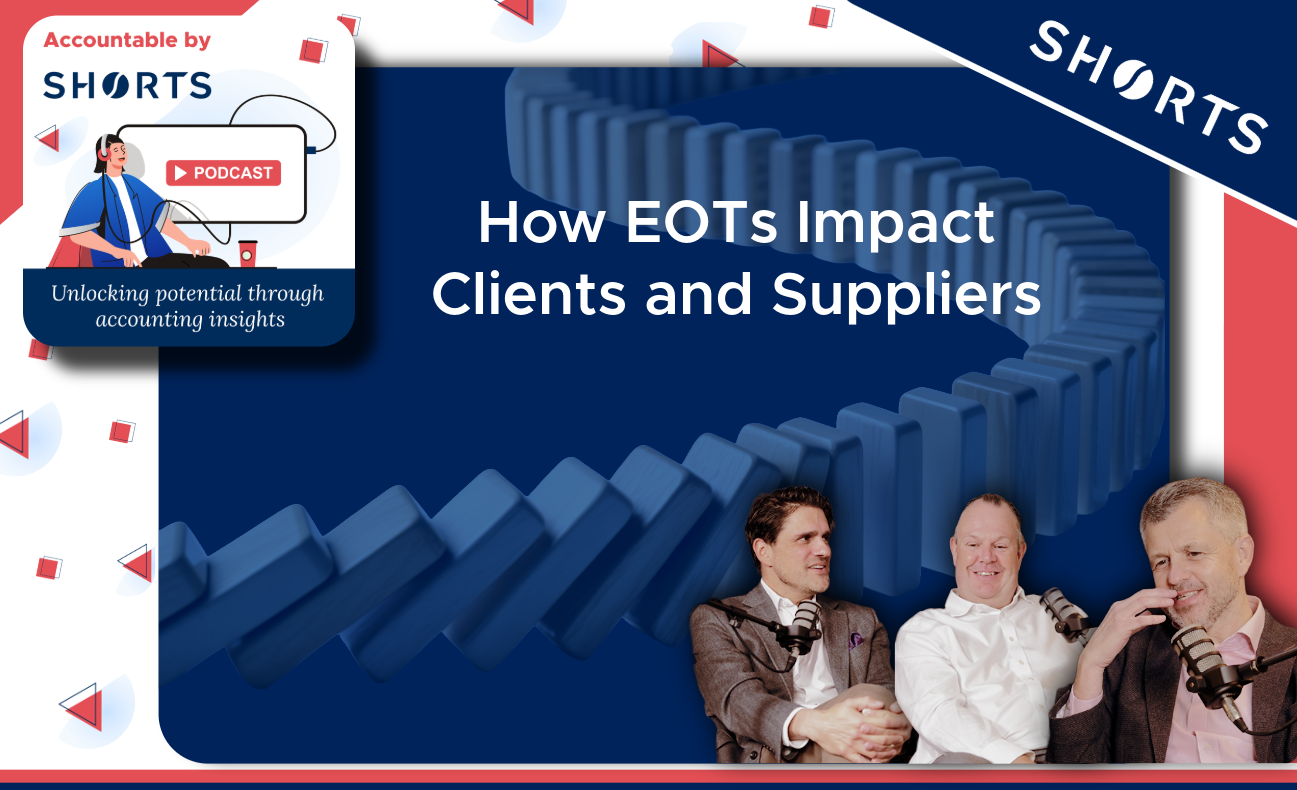
When you sell your business to an Employee Ownership Trust (EOT), most advice focuses on internal communication, in particular, how to reassure employees and prepare your leadership team. But what about the outside world? How do customers and suppliers react when they hear about your EOT?
We explored this very questions in our recent conversation on Accountable by Shorts with Andrew Mills from T Allen Engineering and Nik Pratap of Pratap Partnership, two business owners who’ve completed EOT transactions. Their insights below highlight why suppliers and customers need to know your EOT news, and how you can make it a positive story for them.
1. Expect curiosity, and sometimes misconceptions
“Some people look at you as if, ‘Are you still engaged? Are you now just swanning around?’”
In our podcast, Nik Pratap admitted he was apprehensive about how clients would perceive the change. Would they assume he’d lost interest? Would they worry about continuity?
The reality? Most customers and suppliers were supportive, and only a few needed reassurance that the founder was still committed and the business was stable.
2. Be proactive with key clients
“Make sure you take the time to explain it to them.”
When it comes to sharing the EOT news with employees, Andrew Mills warns business owners to avoid waiting for questions to arise. For major clients, schedule a conversation to explain what an EOT means for them:
- Continuity: The business is now protected for the long term.
- Stability: No risk of being carved up by a trade buyer.
- Commitment: The leadership team remains engaged and focused.
Mills framed it perfectly:
“As a sole shareholder, I could have sold to anyone. Now, the company is more secure than ever.”
3. Keep the message simple
Both Nik and Andrew agreed that employee ownership trusts aren’t widely understood, so avoid jargon. Focus on what matters to your customers:
1. Service won’t change.
2. Your team is invested in the business’s success.
3. The EOT structure strengthens your ability to deliver long-term value.
4. Make it a positive story
“It’s a wonderful story and I’m proud to tell it.”
For Nik, an EOT isn’t just a transaction; it’s a statement about your values. It shows you care about your people, your customers, and your legacy. For business owners considering an EOT, share that narrative:
- Why you chose EOT over a trade sale.
- How it aligns with your culture and purpose.
- What it means for the future of your business.
Nik was able to sum up his focus for the future with the following quote:
“I didn’t want to be sat in a pub at 75 saying, ‘I built a business... and it’s gone.’ I wanted it to carry on.”
5. Use transparency to build trust
Suppliers and customers appreciate honesty. Let them know your exit timeline and reassure them that governance structures are in place to maintain standards. As Andrew Mills said:
“I’ve been very transparent — no surprises, no last-minute announcements.”
Key takeaway
Handled well, an EOT can strengthen external relationships. It signals stability, continuity, and a people-first approach. So don’t just manage perceptions — shape them. Tell your story proudly, and turn your EOT into a competitive advantage.
Shorts' Corporate Finance team have worked with many businesses on EOT transitions, helping business leaders through the process. If you want to explore an EOT as part of your business exit plan then our team can assist.

Andy Ryder
Andy leads the award-winning Shorts Corporate Finance team. A Partner at Shorts, Andy specialises in corporate finance and strategic advisory services for owner-managed businesses. With more than 14 years of experience, he advises clients on acquisitions, disposals, management buyouts, fundraising and due diligence, helping business owners navigate major decisions with confidence and achieve the best possible outcomes.
View my articlesTags: EOT