
For any business owners considering their succession plan, the UK tax landscape can make the decision a daunting one, especially given the current discussions over potentially higher taxation of capital and wealth. Shorts Corporate Finance Partner Andy Ryder analyses the landscape and shares his thoughts on whether business owners should accelerate their exit plans, or hold and focus on future growth.
Tax headwinds vs strong valuations
The UK tax environment has evolved in a way that many business owners perceive as increasingly challenging, with reduced certainty. Rising Capital Gains Tax rates, reduced reliefs, changes to Inheritance Tax treatment, political discussion around wealth taxation and global pressures limiting economic growth collectively point toward a clear trend: uncertainty, with the potential for greater taxation of capital and wealth.
However, this is only one side of the equation. At the same time, valuation multiples for quality UK businesses remain robust by historical standards, creating a potentially compelling, yet time-sensitive, exit window.
20 years of CGT change: from incentive to erosion
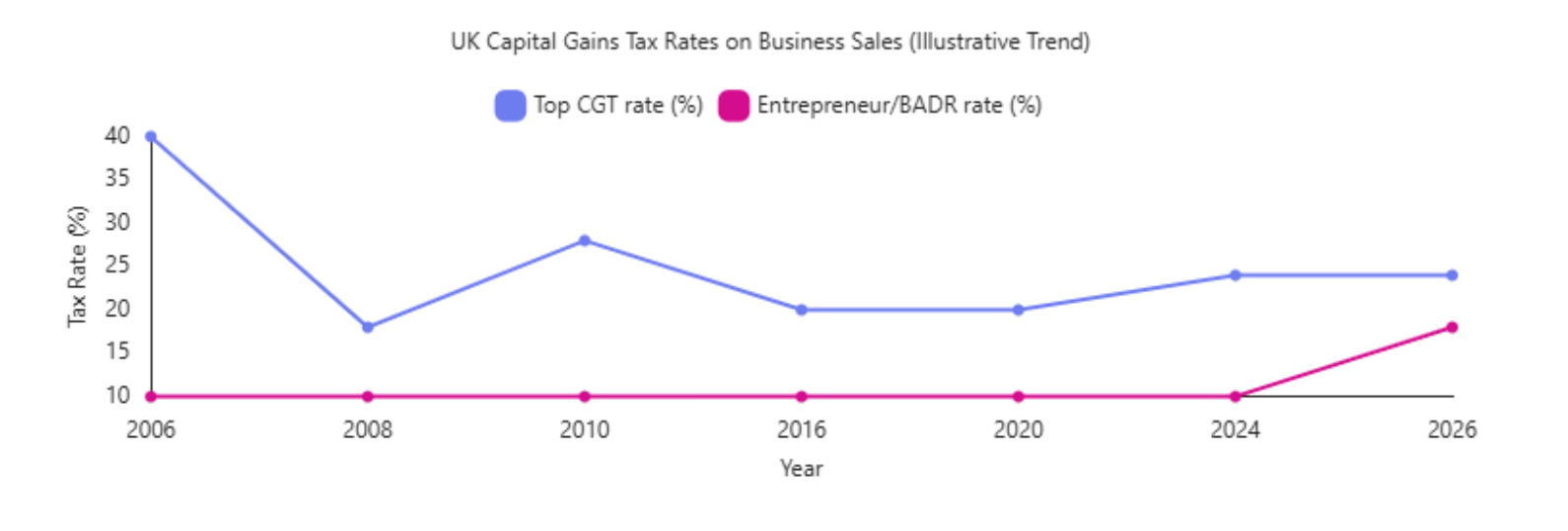
The visual below illustrates the long-term trajectory of CGT rates alongside the preferential “entrepreneur” rate (Entrepreneurs’ Relief / Business Asset Disposal Relief [BADR]).
Key observations
- Pre‑2008: Effective tax rates as low as ~10% on business assets due to taper relief
- 2008 reform: Flat 18% main rate introduced, business assets benefit from Entrepreneurs’ Relief at 10%
- 2010–2020: Stable, highly attractive regime with 10% Entrepreneurs’ Relief and lifetime limits rising to £10 million
- 2020 onwards:
- Entrepreneurs’ Relief replaced with BADR
- Lifetime relief limit cut to £1m
- Main rate rises in 2024
- CGT annual exemption reduced substantially
- 2025–2026:
- BADR rises from 10% → 14% → 18%
Strategic interpretation
The direction of travel is clear:
- Preferential treatment for entrepreneurs has been diluted.
- The UK is moving closer to mainstream capital taxation.
Beyond CGT: a broader tightening of the regime
1. Inheritance Tax: BPR reform
From April 2026:
- 100% relief capped at £2.5m
- 50% IHT applies thereafter
This represents a fundamental change:
- Historically: since 1992, businesses could pass to the next generation largely tax-free.
- Going forward: material IHT leakage for estates, including larger businesses.
2. Wealth Tax: will it become reality?
While not yet enacted, the debate is intensifying:
- Proposals of a 2% tax on wealth above £10m have been discussed
- Government figures have refused to rule out such measures
- Measures like the possible “mansion tax” may represent early structural steps toward wealth taxation
The key issue is not certainty but directional risk.
A counterbalance: strong UK exit multiples
Despite tax headwinds, the UK Mergers & Acquisitions market remains resilient.
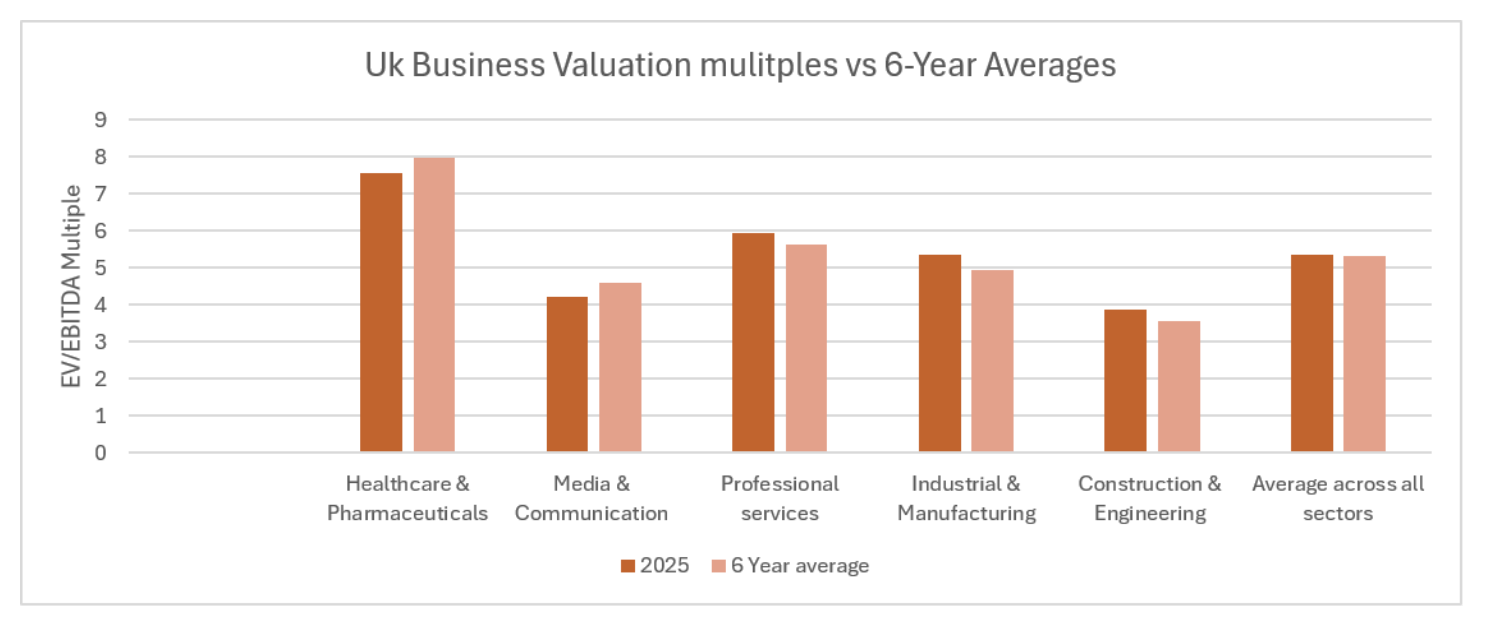
The chart below illustrates indicative current EV/EBITDA valuation multiples versus six-year averages across key sectors.
Key takeaways
Across most sectors:
- Healthcare & Pharmaceuticals: ~7.6x vs 8x historical
- Media & Communication: ~4.2x vs 4.6x
- Professional Services: ~6x vs 5.6x
- Industrial & Manufacturing: ~5.4x vs 4.9x
- Construction & Engineering: ~3.9x vs 3.6x
- Average across all sectors: ~5.4x vs 5.3x
Why are multiples still strong?
Several structural factors are supporting valuations:
1. Continued private equity demand
- High levels of dry powder
- Strong appetite for “platform” investments
2. Scarcity of quality assets
- Well-run UK SMEs remain highly attractive.
- Buyers prepared to pay premiums for resilience and recurring income models.
3. Strategic buyers still active
-
Corporate acquirers seeking growth in a low GDP environment.
The strategic tension facing owners
This creates a unique moment of dual forces:
|
Factor |
Direction |
|
CGT rates |
Increased |
|
Reliefs (BADR, AEA) |
Decreased |
|
IHT efficiency |
Declined |
|
Wealth tax risk |
Uncertain |
|
Valuation multiples |
Stable |
What does this mean in practice?
For many shareholders, the decision framework is shifting:
Historically:
“Grow further, exit later, tax-efficiently.”
Increasingly:
“Balance growth upside versus tax erosion and policy risk.”
The case for reviewing exit timing
This is not an argument for rushed disposals. However, there are several reasons why a proactive review is prudent:
1. Tax arbitrage opportunity
Locking in:
- CGT rates if further increases are anticipated
- BADR if further restriction is anticipated
- Possible wealth taxes
- Possible further IHT restrictions
- Potential alignment of CGT with Income Tax (a recurring policy theme)
2. Valuation arbitrage
Selling into:
- Strong buyer demand
- Stable multiples
3. Risk management
Reducing exposure to:
- Possible wealth taxes
- Possible further IHT restrictions
- Potential alignment of CGT with Income Tax (a recurring policy theme)
Conclusion
For UK business owners, the key takeaway is not that an exit is essential, but that:
The balance of advantage between waiting and acting has shifted. There may be a narrowing window.
In a world where:
- Tax costs have risen
- Reliefs have decreased
- Policy risk may be higher
…and yet:
- Buyers remain active
- Valuations remain strong
…it may be one of the most important times in recent history to actively reassess your exit strategy.
Assess your exit plan
If you're unsure whether your succession strategy will be vulnerable to the changing tides of the UK's tax landscape, Shorts can help. Our Corporate Finance team has assisted business owners with complex company structures and various long-term goals and found the right solution for their needs.
Note: The charts above are illustrative but grounded in prevailing tax rates and typical mid-market valuation ranges. Individual circumstances will vary and professional advice should always be sought.

Andy Ryder
Andy leads the award-winning Shorts Corporate Finance team. A Partner at Shorts, Andy specialises in corporate finance and strategic advisory services for owner-managed businesses. With more than 14 years of experience, he advises clients on acquisitions, disposals, management buyouts, fundraising and due diligence, helping business owners navigate major decisions with confidence and achieve the best possible outcomes.
View my articlesTags: succession planning