Growth shares offer business owners the opportunity to incentivise key employees with a stake in the business, helping to drive growth for all shareholders.
These types of arrangements can be valuable to business owners and employees alike, but there are complexities regarding structuring, valuations, and various tax implications that require careful navigation.
What are growth shares?
Growth shares are used to reward and motivate key employees by giving them a stake in future growth without giving away existing value.
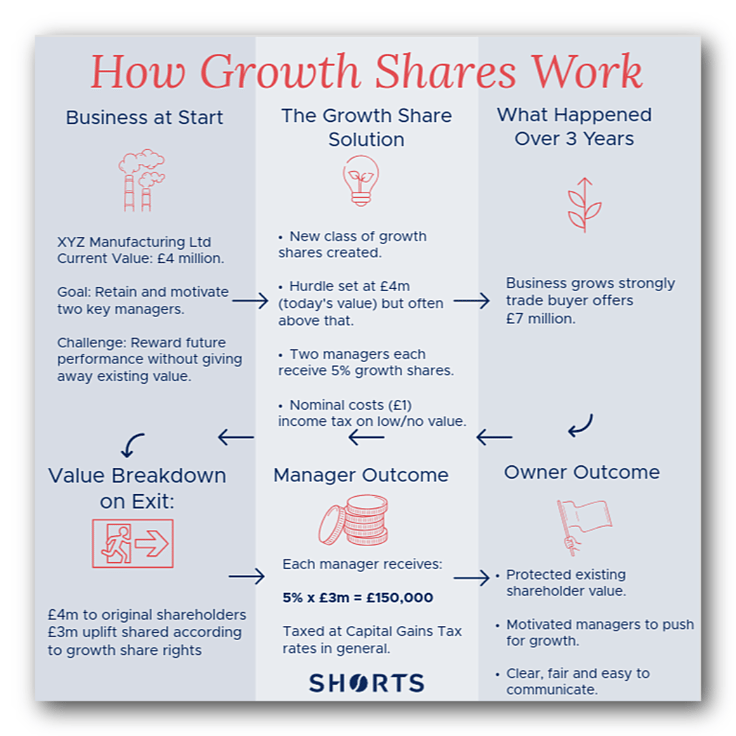
They are typically issued as a new class of shares that only benefit from increases in the company’s value above an amount that you agree, referred to as the “hurdle”.
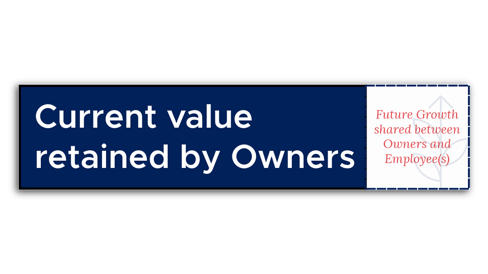
This means the value of the company prior to growth shares being issued can effectively be locked in for existing shareholders and is not diluted, whereas future growth is shared proportionately.
This offers employees a meaningful, performance-based incentive to grow the company, helping with staff retention and aligning key employees with the objectives of the company.
How do growth shares work?
The starting point is to value the company to determine the baseline value being locked in for existing shareholders. This also helps to set the hurdle as you would generally set this as a minimum of the current market value.
A value then needs to be given to the growth shares to establish the tax position for the employee as they are subject to income tax (and potentially National Insurance Contributions [NIC]) reduced by any amount the employee pays up front.
How are growth shares valued?
The value of the growth shares is based on the expected future growth, so the next step is to assess the probability of this happening. The more likely the growth, the higher the value attributable to the growth shares.
As the shares only benefit from growth in excess of the hurdle, and not the existing value of the company, the value of the growth shares is usually fairly low.
This low value placed on the growth shares makes the scheme available to employees who otherwise would not be able to afford to buy into the company at full market value.
Are there any restrictions that influence the value of growth shares?
It is common to place restrictions on the shares such as forfeiture on leaving employment, as well as other restrictions, all of which can reduce the value of the shares.
On the eventual sale of the company, existing shareholders retain the value established at the start and share the growth proportionately with the growth shareholders.
Who really benefits from growth shares?
Business owner/existing shareholders
Business owners have worked hard to build the company and by utilising growth shares can protect the value they have built up to that point.
Offering growth shares provides a long-term incentive to key employees and can be a way for business owners to manage cashflow efficiently who would rather not offer other more common rewards such as increased salary and bonuses.
This aligns employee objectives with that of the company as they will only benefit if the business value grows.
Growth shares can be less restrictive than other share incentive schemes. They are also particularly useful for companies that do not qualify for other schemes, such as Enterprise Management Incentive (EMI) share options.
Employees
Employees are given a stake in the future growth of the company and a tangible future reward for their efforts.
These generally have a low initial cost for the employee due to the low value of shares at issue.
When structured correctly, the disposal of the growth shares can be subject to Capital Gains Tax (CGT) which is generally a lower rate than income tax, therefore making it potentially beneficial than other common forms of reward such as salary and bonuses.
The main downside for the employee is that future growth is not guaranteed. If the hurdle is never met, then they will not receive anything for the shares.
Who can own growth shares?
Growth shares are most commonly awarded to key employees in order to drive growth in the business. However, they can also be issued to various other parties, including directors, consultants, or even companies.
They are flexible and there are no general restrictions on who can own growth shares.
The articles of association would need to be amended to reflect the rights of the shares, and it is possible to place restrictions on who can own the shares at that point if you wish.
How are growth shares taxed?
Income tax
Where the shares are issued by reason of employment, they would fall under Employment Related Securities (ERS) anti-avoidance rules. In simple terms, this means income tax is due on the value of the shares. The value subject to income tax is reduced by any amount paid up front for the shares.
This is applicable when issued to employees and most other people working in and for the business.
There can also be NIC liabilities arising on the issue of the shares, again subject to the value of the shares issued.
Capital Gains Tax (CGT)
When the growth shares are sold, they are generally subject to CGT on disposal by the employee.
The base cost of the shares generally would be any amount paid up front for the shares, plus any amount which was already subject to income tax.
Assuming the plan is structured correctly, and relevant elections are made at the outset, the base cost of the shares should be minimal. This means the majority, if not all, of the increase in value would likely be taxable at CGT rates rather than income tax rates (which are generally lower). This makes growth shares an attractive option for the employee.
CGT reliefs could potentially apply on disposal such as Business Asset Disposal Relief (BADR) further reducing the tax payable on sale.
Pros and cons of growth shares
|
Pros |
Cons |
|
Generally protects existing shareholder value and only shares the value of future growth |
Relies on future growth and employee may not receive anything if hurdle is not met |
|
Low cost to employee |
Cost of accounting/tax advice and legal fees for the company |
|
Aligns employee objectives with company future growth |
More complex for employee to understand – additional explanation may be required |
|
More flexible than other incentive schemes |
May not be as tax efficient as other HMRC-approved incentive schemes |
|
Achieves CGT treatment for employee on disposal |
Additional tax charges if implemented close to a sale |
Growth shares and succession planning
Growth shares help with succession planning by protecting the value built up by the existing shareholders, while allowing for future growth to be shared. Once the key employee(s) are identified, growth shares help to incentivise that next generation of leaders to commit long-term to the growth of the business. This helps promote ongoing continuity from within the business and allows for value to start to shift early and tax efficiently.
The rights attached to the growth shares can be flexible, meaning you can retain more control of the business until such a time when you are prepared to step back. This helps to create a smooth transition of ownership.
Get to grips with growth shares
Growth shares can be a highly useful tool in rewarding employees and promoting growth within the business.
We have outlined the general use and benefits of a growth share scheme, but implementing it requires careful planning and input from multiple sources.
Here at Shorts, we can assist you by:
- Assessing whether a growth share scheme is the right fit for you.
- Design the structure based on your objectives - including setting the hurdle and rights of shares.
- Prepare the valuations – the existing value of the company and assessing prospective growth.
- Explain the tax consequences for both employer and employee in more detail.
- Completing the compliance aspects including all relevant forms and elections.
- Coordinating the legal requirements - we work closely with solicitors who can assist with the legal aspects of the share rights and amending the articles of association.
Our Tax Planning team can assist you with the structuring aspects while our Corporate Finance team assist with the required valuations and forecasts.
Growth shares FAQs
What are the main benefits of growth shares?
They protect existing value while allowing for future growth to be shared.
When should I consider growth shares?
If you want to reward and incentivise key employees. Business leaders considering succession planning, particularly where other options such as EMI schemes are not available, should also consider growth shares.
Can any business issue growth shares?
Any company with shares can issue growth shares. There is no restriction on size or nature of the business like there is with other share schemes. Sole Traders, Partnerships and LLPs would not be able to issue growth shares by nature of not having share capital.
What happens to an employee’s growth shares if they leave?
This would entirely depend on the conditions you decide to attach to the shares. It is common to have provisions in place for the shares to be forfeited on leaving but more favourable treatment can be given to ‘good’ leavers if you wish.
.jpg)
David Southern
David has more than a decade of tax experience. He holds a Chartered Tax Adviser (CTA) qualification, and particularly enjoys advising clients on their Business and Personal Tax Planning activities to ensure they're compliant, using reliefs and opportunities available to them, and maintaining their tax obligations.
View my articles