.png)
For years, the UK's R&D tax relief system could be measured by a simple rule: more claims meant more innovation. The latest figures from HMRC suggest that relationship is becoming more complicated. While the number of claims fell sharply in 2024/25, the overall value of support and the amount businesses invested in research and development both continued to rise.
For innovation-led businesses across South Yorkshire and Derbyshire, that's perhaps the most important takeaway from HMRC's latest R&D statistics.
According to the report, companies claimed an estimated £8.2 billion of R&D tax relief support during 2024/25, up 5% on the previous year. Meanwhile, qualifying R&D expenditure increased to £51 billion, representing growth of 7% year-on-year.
Undoubtedly, businesses are still investing heavily in innovation. The intriguing part is that they're doing so while the number of claims is falling. HMRC estimates that total R&D tax relief claims dropped by 17% to around 40,325 in 2024/25, continuing a downward trend seen over recent years.
At first glance, that might look like bad news. It isn't necessarily.
Decline in innovation or improvement in compliance?
Much of the decline appears to reflect reforms aimed at improving compliance and reducing incorrect claims. HMRC points to the continuing impact of the Additional Information Form (AIF), which became mandatory in 2023 and requires businesses to provide significantly more detail about their R&D activities before submitting a claim. The result is a system that appears to be becoming more selective.
An observer might conclude that Britain's R&D tax regime is moving away from rewarding volume and towards rewarding substance. There may be fewer claims entering the system, but the remaining claims are increasingly larger and more valuable.
Trends in R&D across Britain's innovation
Average claim values increased by 27% during 2024/25, while claims worth more than £2 million increased both in number and value. Just 6% of all claims accounted for 69% of the total relief claimed.
That concentration mirrors a broader trend within Britain's innovation economy. While thousands of businesses claim R&D relief, much of the expenditure remains concentrated among larger and more established innovators.
For South Yorkshire and Derbyshire, however, this isn't necessarily a disadvantage.
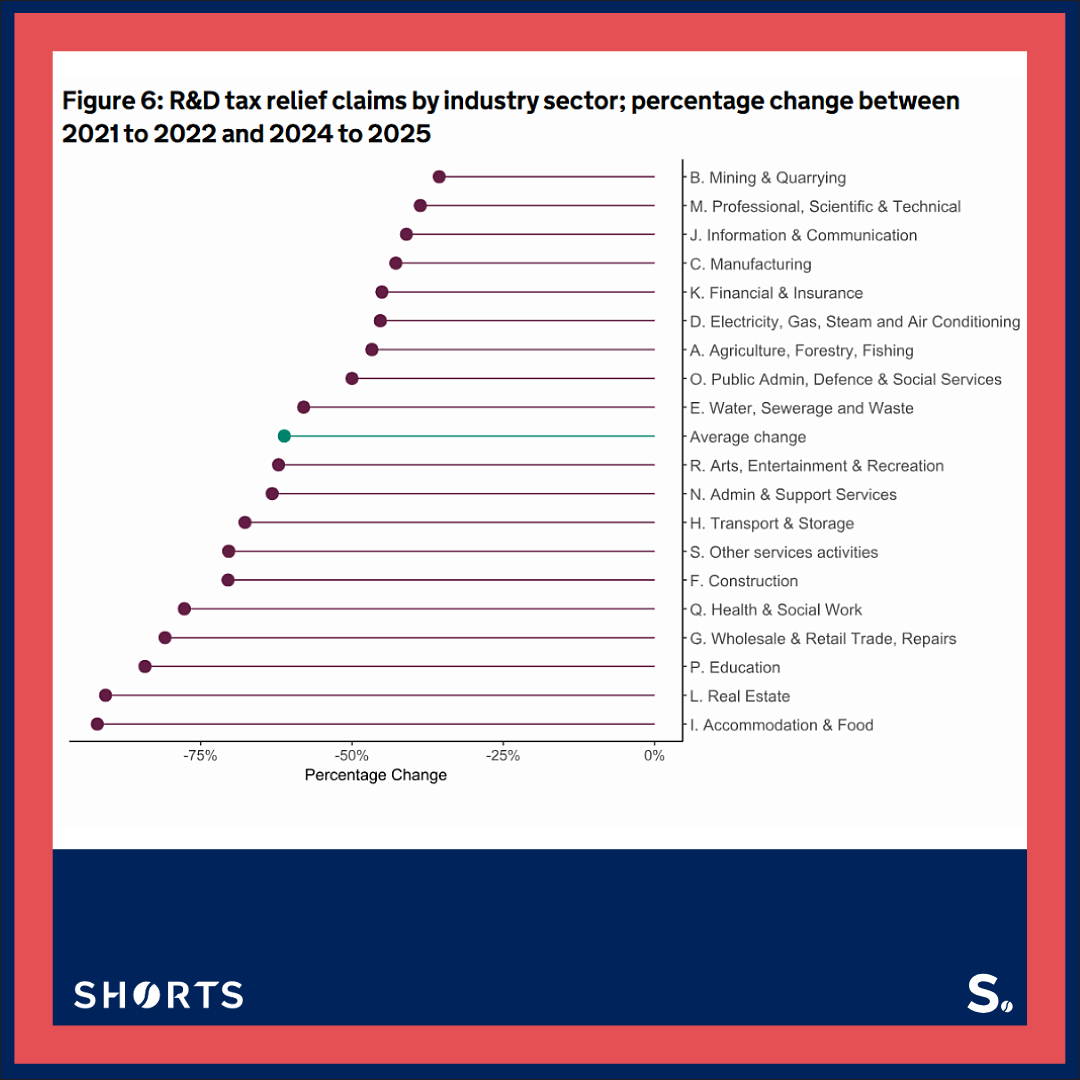
The sectors claiming the most R&D relief nationally remain Manufacturing, Information & Communication, and Professional, Scientific & Technical services. Together they account for 75% of all claims and 71% of the relief value. Manufacturing alone represented 27% of both claims and total relief claimed.
Those sectors happen to align closely with many of the region's strengths.
South Yorkshire and Derbyshire set up for R&D success
South Yorkshire continues to build its reputation around advanced manufacturing, materials science and engineering innovation, supported by institutions such as the AMRC and a growing cluster of technology-led industrial firms. Derbyshire's economy similarly contains a substantial base of engineering, manufacturing, aerospace supply chain and specialist industrial businesses.
The businesses developing new production methods, proprietary processes, industrial software or patented technologies are precisely the sorts of organisations likely to benefit from R&D relief.
Another notable development is the introduction of the government's new Merged R&D Expenditure Credit (Merged RDEC) scheme and Enhanced R&D Intensive Support (ERIS) regime. Introduced for accounting periods beginning on or after 1 April 2024, these reforms effectively replace the previous SME and RDEC systems and create a more unified framework for many claimants. As with most tax reforms though, the transition creates both opportunities and confusion.
Are SMEs missing out?
Many SMEs that previously claimed under the traditional SME scheme are now using the new Merged RDEC structure. This has contributed to a sharp reduction in SME-specific claims, even though innovative activity itself appears to have remained relatively resilient.
A falling number of claims does not necessarily mean businesses are conducting less research and development. In fact, the increase in qualifying expenditure suggests the opposite. Companies are spending more on innovation overall, even as the administration and structure of the relief evolves.
The regional data follows a familiar pattern. Businesses registered in London accounted for 24% of claims and 30% of total relief, with the South East and East of England also capturing a significant share. However, HMRC is careful to note that these figures reflect registered office locations rather than where R&D activity actually takes place.
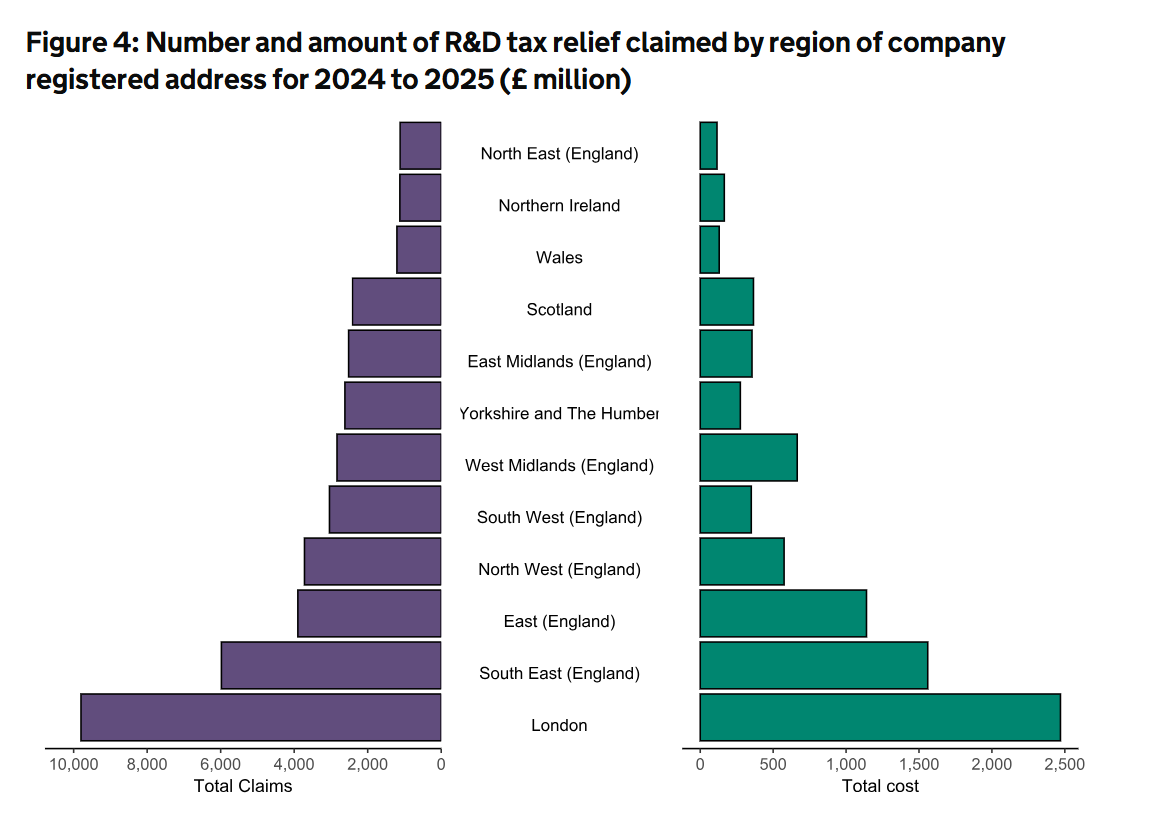
Many nationally operating groups maintain headquarters in London while employing engineers, developers and technical specialists elsewhere. A company may record its claim in the capital while carrying out a substantial proportion of its research, testing and innovation activity in Sheffield, Chesterfield or the surrounding area.
The bigger picture is therefore encouraging. Despite increased compliance measures, changing claim rules and significant reform to the relief structure, UK businesses continue to increase their R&D spending. The tax system may be supporting fewer claims, but it is supporting larger investments.
Claim R&D tax credits
For ambitious businesses across Derbyshire and South Yorkshire, the message is clear. Innovation remains one of the strongest routes to growth, and the government continues to provide substantial tax support for companies willing to invest in it.
The rules have simplified under the Merged RDEC scheme and ERIS (Enhanced Research Intensity Scheme), especially around some of the more complex areas such as contracted out R&D and overseas costs. As the latest figures demonstrate, the rewards remain significant.

Darryl Hoy
Darryl is the Technical Director of the Radius team. He is a specialist in Research & Development tax reliefs, having previously worked at HMRC as an R&D Tax Inspector.
View my articles