Many accounting packages dashboards and spreadsheets now arrive with AI features bolted on, promising faster and better MI reports. Yet even newcomers to AI know there are risks. What management information reporting can a business safely hand to a machine, and how much weight should its findings carry with leaders?
The answer, says Shorts Genus Partner Alicia Williams, lies in your reporting foundations. Having helped dozens of businesses build modern MI reporting systems, she’s outlined the tasks AI does well, the ones it shouldn’t touch, and the steps business owners and finance directors should take before inviting it into the reporting cycle.
Key takeaways:
- AI in MI reporting is only as reliable as the data and prompts beneath it. Fix the foundations first.
- Hand AI the repetitive work: data cleansing, aggregation, scheduling, anomaly spotting and first-draft commentary.
- Keep humans on anything requiring context or accountability: sign-off, strategy, compliance interpretation and governance.
- Review access permissions and data-protection obligations before connecting AI tools to financial data.
- Treat AI as an enthusiastic junior colleague. Useful, quick, and in need of supervision.
How does AI work with Management Information reporting?
Artificial Intelligence (AI) uses natural language processing and raw data amalgamation to automate, enhance, and summarise reports that have been pulled and produced manually in the past.
The difference is AI can use machine learning to apply pattern recognition and summarise findings in everyday language in MI reporting. In contrast, a finance director would spend an afternoon immersed in spreadsheets to attain the same results.
How accurate is it?
AI findings are only as good as the prompt and data foundations they’re built on. If the model is fed duplicated invoices, inconsistent cost codes or a half-migrated chart of accounts it will produce fluent, plausible and wrong analysis.
AI models are built on probabilistic text generation, meaning it will not flag its own uncertainty with any reliability. Instead, it will fill gaps with confident guesses. Accuracy in AI-assisted MI reporting relies on the data quality, metrics and prompts you feed it.
Can AI take over management information systems?
Not in the way people imagine. AI can run parts of the MI reporting process, but it cannot provide the context that is essential towards interpreting the results. Moreover, a human must maintain data quality across their reporting to ensure the findings AI shares are accurate.
AI-assisted MI reporting exists to provide evidence to make decisions, but these still need someone accountable for them. For business leaders, AI should do the heavy lifting, but keep the thinking to humans.
What tasks can you typically give to AI?
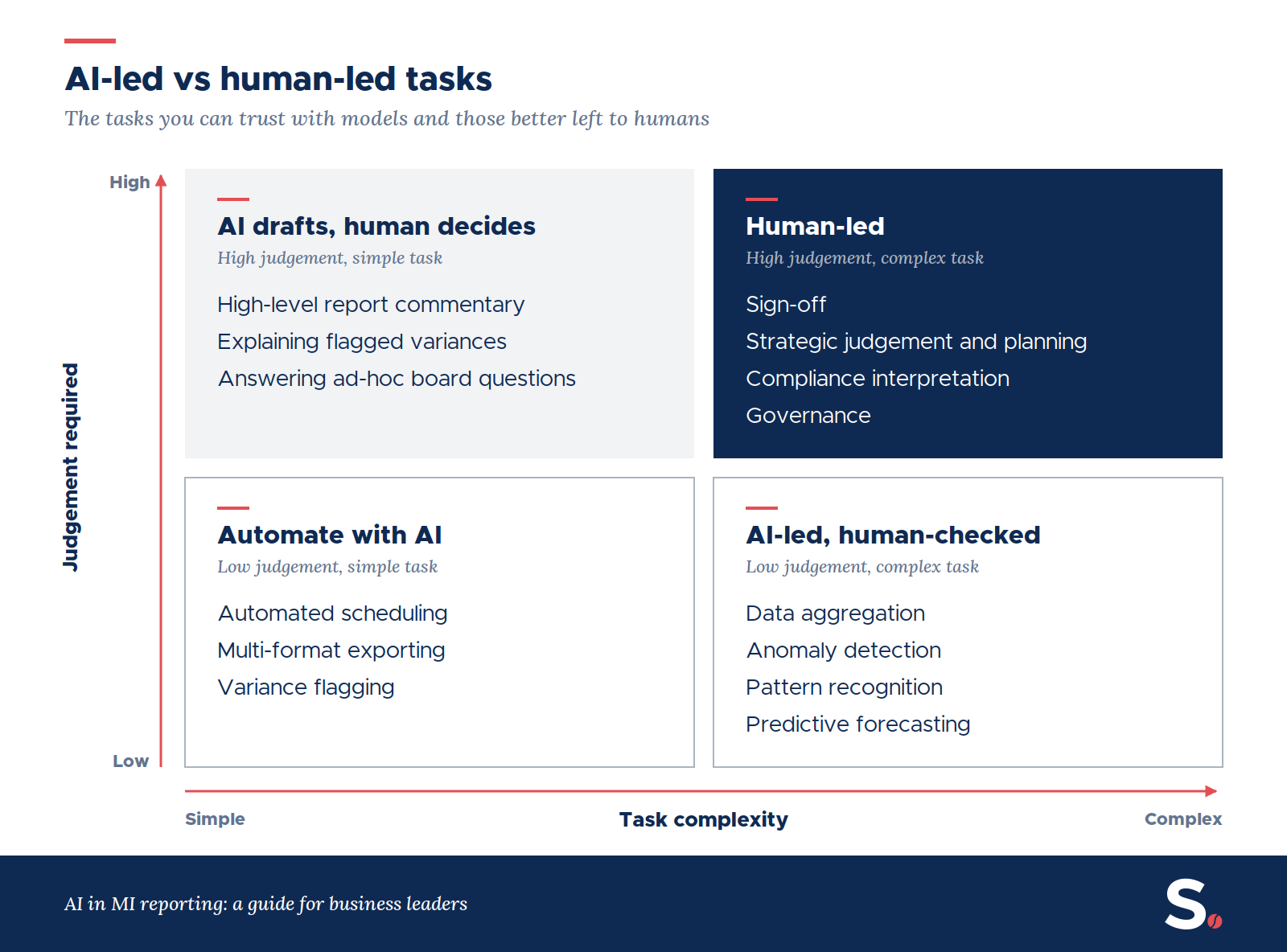
AI excels at repetitive, data-driven tasks to help you save time and identify anomalies and patterns. Used well, it saves time and spots anomalies and patterns a tired analyst might miss. The tasks below fall into four groups.


Once the underlying accounting records have been prepared, reconciled and reviewed, finance teams can use AI to help draft commentary and management information using validated company-specific data.
What reporting work should you leave to humans to handle?
There is one area of management reporting where human judgement still reigns supreme: context. You will know why certain decisions were taken and what you wanted to achieve. You know your industry in detail and what business and personal goals you hold for the future.
Based on the above, these are the MI reporting tasks you should avoid outsourcing to AI:
- Sign-off: someone must be accountable for the accuracy of reports and decisions made off the back of this data.
- Strategic judgement and planning: AI can model scenarios, but choosing between them depends on appetite for risk, market knowledge and ambitions that models cannot see.
- Compliance interpretation: applying accounting standards, tax rules and regulatory requirements calls for professional judgement and carries professional liability.
- Governance: deciding who sees what, how controls operate and how exceptions are escalated is a matter of oversight, not automation.
- Communicating the story: explaining difficult results to staff, lenders or shareholders needs credibility and tact.
AI will not know to incorporate additional factors outside the business unless you explicitly tell it. For instance, perhaps a business's turnover is down because staff have taken more holiday that quarter. Even then, it's best for a human to analyse the results and ensure they are accurate.
Human-led vs AI-led reporting tasks
It is important to distinguish between preparing management accounts and using AI to enhance management information. Producing reliable management accounts requires robust bookkeeping, reconciliations, appropriate accounting adjustments and professional review. AI can then help businesses interrogate that information, identify trends and present insights more efficiently.
How can I get started?
Alicia recommends businesses start small. Get AI to interview you before asking it to output any commentary. It will then bring out some of the elements in the above by asking 'why' on various elements. The commentary it provides will be more useful and relevant to your business.
Ian Snow at Central Technology suggests business owners start with the basics:
- Permission rights: ensure sensitive reports and stats are accessible to the relevant people only.
- Data quality: set a regular cadence to review and clean your data – this must be an ongoing task.
- Metrics: ensure the metrics you’re using are relevant to the decisions you need to make.
In some cases, applying AI to your MI reporting can help improve the hygiene of your business's operational practices as it surfaces issues that may be lurking under the surface. Xero's findings in its 2026 Modern Practice Playbook report2 found that among UK accountancy practices actively using AI every day, 87% rate their core business processes as well-documented. Meanwhile, in practices with no plans to adopt AI, that figure drops to just 18%.
Both Alicia and Ian discuss this in more detail in the AI and MI Reporting episode of Accountable by Shorts.
How can AI improve management information reports in business settings?
The gains in AI are in time and attention. Finance teams and business owners should have more free time to analyse and action findings faster where they previously compiled data.
What type of business or department are best for this?
AI-assisted MI reporting pays off fastest where data volumes are high and reporting is frequent and repetitive. The following businesses that would benefit include:
- Multi-site retailers
- Hospitality groups
- Professional services firms tracking utilisation
- E-commerce businesses with high transaction volumes
- Groups consolidating several entities
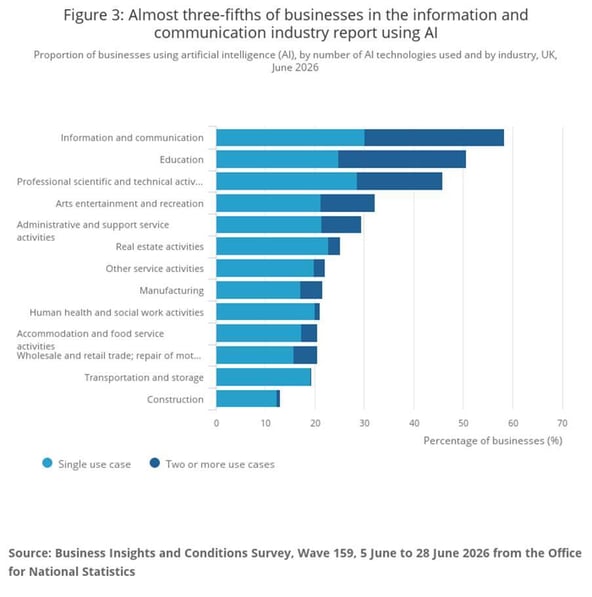
A 2026 report from the Office of National Statistics1 shows industries in Information and Communication, Education, and Scientific and Technical Activities have deployed AI the most.
Corporations will find sales and operations, where pipeline, productivity and headcount reporting follow predictable rhythms. Very small firms with simple books may find the effort of setting up outweighs the reward, at least for now.
Which tools or software should you use to pull this data?
Most businesses already own more AI capability than they realise. Cloud accounting platforms such as Xero, QuickBooks and Sage increasingly include AI-driven categorisation and insights.
The right choice depends on fit: what integrates with your existing systems, where your data will be stored, and whether the vendor's data-protection terms meet your obligations. A management information accountant can help match tools to your needs, and adjust them as your business changes.
How can business leaders build solid foundations for reliable AI-powered reports?
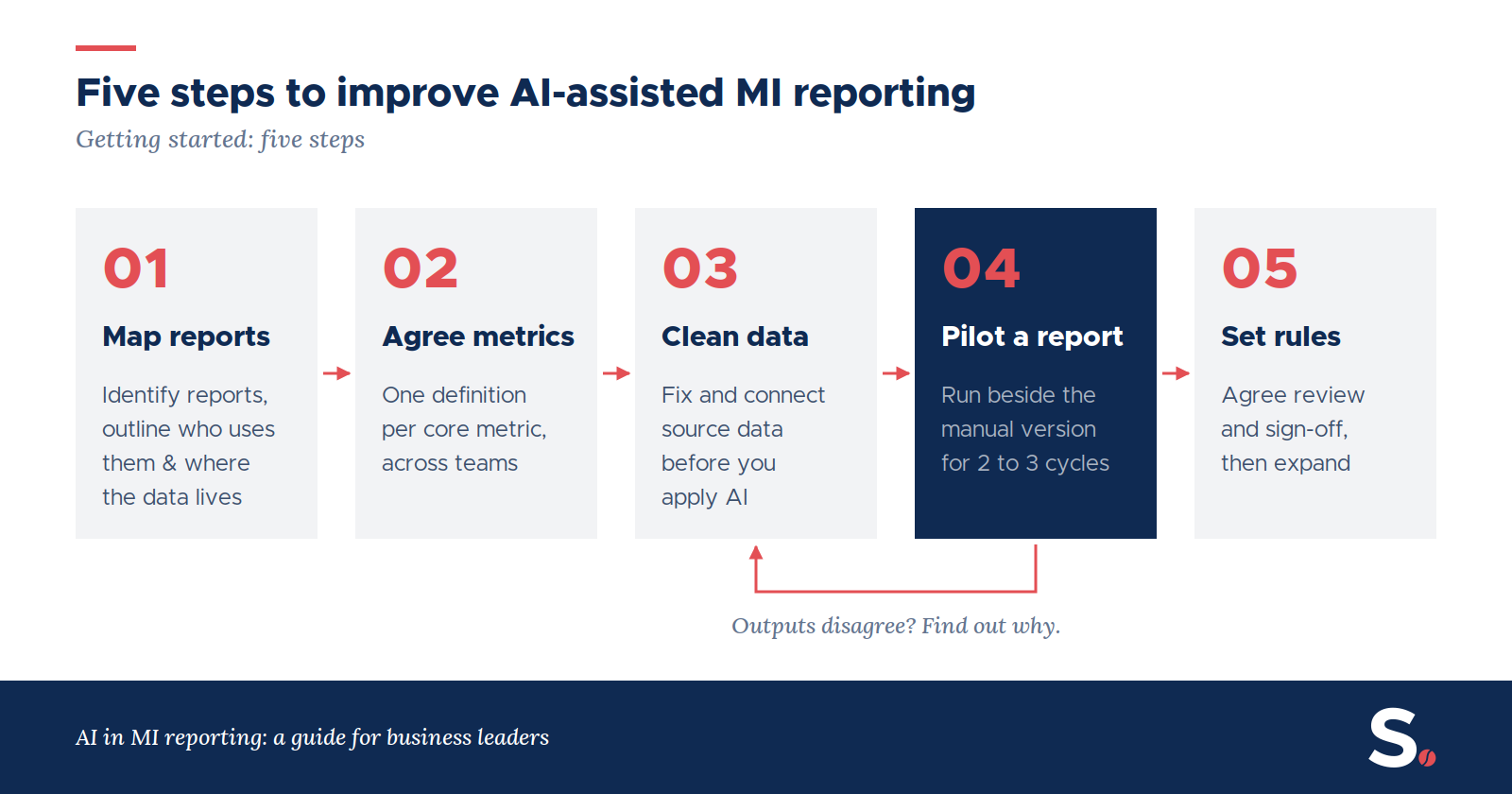
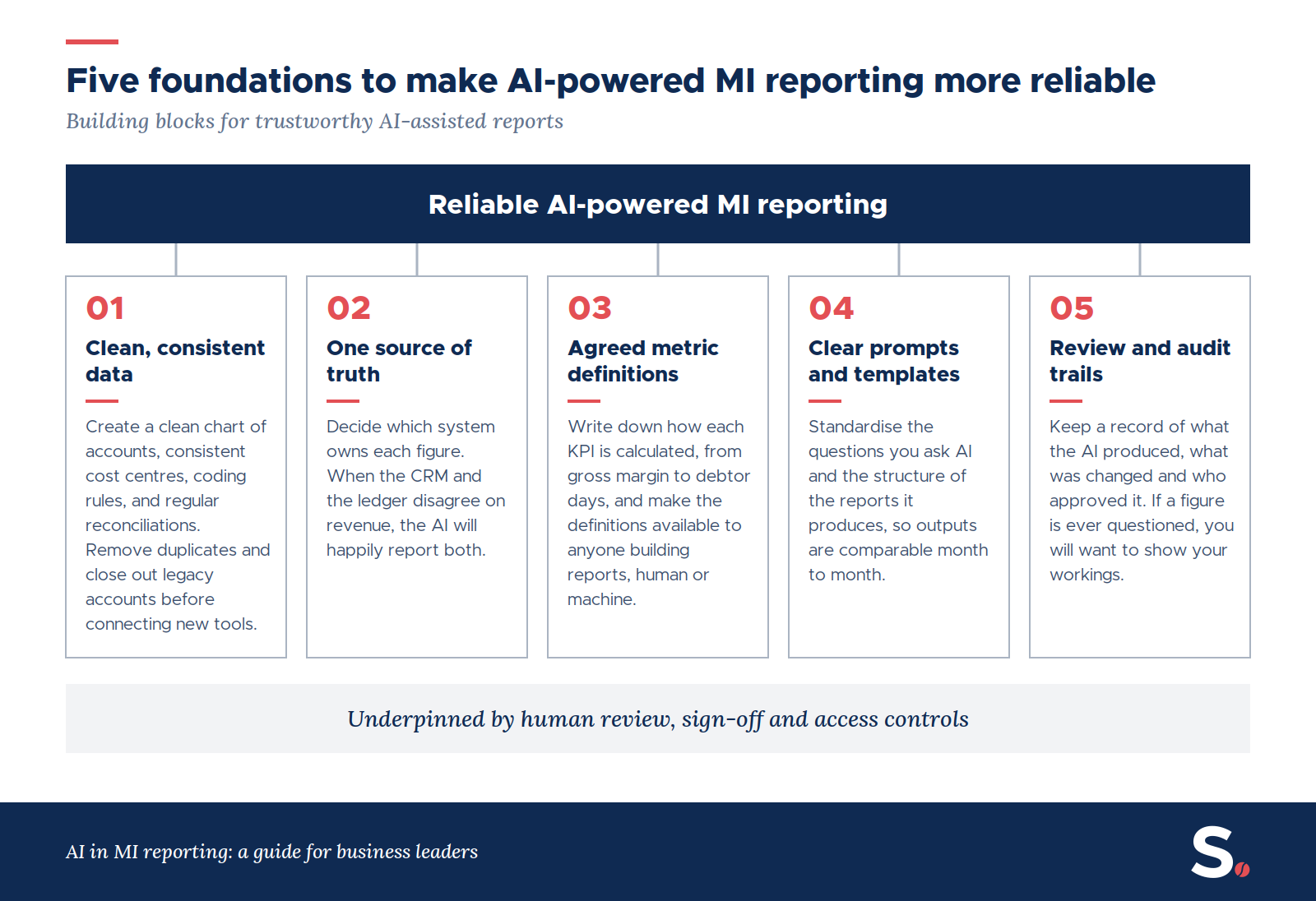
In truth, the majority of work happens before AI arrives. A model cannot reconcile what was never recorded properly. Five foundations matter most.
What key performance indicators should an AI-powered management information report include?
The right KPIs depend on your sector, but most AI-powered MI reporting should cover the following.
|
Area |
Example KPIs |
Where AI adds value |
|
Profitability |
Revenue, gross margin, EBITDA, net profit |
Variance flagging against budget and prior year |
|
Cash and liquidity |
Cash position, 13-week cash forecast, debtor and creditor days |
Predictive cash-flow forecasting |
|
Growth and sales |
Pipeline value, conversion rate, customer acquisition cost |
Pattern recognition across sales and marketing data |
|
Operations |
Utilisation, stock turnover, order fulfilment time |
Anomaly detection in operational data |
|
People |
Headcount, staff turnover, revenue per employee |
Trend analysis over time |
Resist the urge to measure everything. A report with forty KPIs is a report nobody reads. Choose the handful that drive decisions and let the AI watch the rest for exceptions.
What are the core components of an effective AI-driven MI report?
An effective AI-driven MI report is the same as a traditional one: it contains the essential data and context to help people make educated decisions.
This usually includes:
- An executive summary: a short, AI-drafted, human-edited overview of what happened and why it matters. Put this at the top of the report for time-strapped leaders.
- KPI dashboard: headline metrics against budget, forecast and prior periods, with clear visualisations. Make it easy for people to find the stats they need.
- Exceptions and variances: items the AI has flagged as outside tolerance, each with an explanation added by someone who knows the business.
- Forecasts: set forward-looking projections, labelled clearly as estimates with their key assumptions stated.
- Commentary and actions: outline what management intends to do, and who owns each action.
- Data notes: include sources, refresh dates and any known data issues, so readers know how far to trust each figure.
These tools are most effective when working with accurate, properly reconciled financial information. AI does not replace the accounting processes, adjustments and professional judgement required to produce reliable management accounts.
What cybersecurity risks exist when adopting AI into MI reporting?
A typical oversight for many businesses are permission rights for documents, users and workspaces. AI assistants are diligent readers: connect one to a shared drive and it may surface the payroll file or a confidential disposal plan to anyone who asks the right question. Review access rights regularly and clean up shared spaces before switching AI tools on, not after.
Other risks deserve the same attention:
- Data leakage: pasting financial or personal data into consumer AI tools may mean it is stored or used outside your control. Use business-grade tools with clear contractual terms.
- Data protection compliance: MI reports often contain personal data, from salaries to customer details. Check that any AI tool supports your obligations under UK GDPR and the Data Protection Act 2018, including data processing agreements, data location and retention.
- Third-party and supplier risk: each new integration is another door into your systems. Assess vendors' security credentials before connecting them.
- Manipulated or poisoned data: inaccurate data, whether accidental or malicious, can skew AI outputs. Validation checks and human review remain essential.
- Over-reliance: the quietest risk of all. If nobody can produce the report without the AI, nobody can tell when it is wrong.
A short AI usage policy, setting out approved tools, permitted data and review responsibilities, is a cheap insurance policy. Your data protection lead or adviser should be involved from the start.
The best approach to AI-led MI reporting, according to Alicia
Treat AI like an enthusiastic, junior member of staff when it comes to your business reporting. While it can learn quickly and take on time-consuming, repetitive tasks, it should never be left without support. Nor should it be making impactful decisions in isolation.
Give AI clear instructions, check its work, and gradually extend its responsibilities as it earns your trust.
The businesses getting the most benefits from AI in MI reporting are those that do the dull work first: tidy data, assign clear definitions and apply sensible controls. Get those right and AI becomes a genuine advantage. Skip them and it merely produces errors at greater speed.
Get a helping hand with your management information reporting
The real opportunity for businesses isn't AI replacing the finance professional, but AI giving finance teams and advisers better tools. When reliable financial information, professional judgement and AI-enabled analysis come together, businesses can spend less time producing information and more time understanding what it means and deciding what to do next.
Whether you are building MI reporting from scratch or wondering whether your existing reports are ready for AI, our team can help. Shorts Genus works with business owners and finance directors to design reporting systems that are reliable, compliant and genuinely useful for decision-making.
Get in touch with Alicia and the Genus team to discuss your MI reporting.
1. Macroeconomic Insights team. (2026, July 19). Artificial intelligence in UK businesses. Office for National Statistics. Ons.Gov.Uk. https://www.ons.gov.uk/businessindustryandtrade/business/businessservices/articles/artificialintelligenceinukbusinesses/2023to2026
2. Xero. (2026). Xero modern practice playbook. https://brandfolder.xero.com/NE531UQB/at/tgh6v2cvwr7bq8v6bvs2q57/UK_-_Xero_Modern_Practice_Playbook.pdf

Alicia Williams
I am Partner of the Genus team at Shorts, a chartered certified accountant and Xero specialist. I specialise in cloud-based accounting solutions, particularly Xero and add-on software, helping clients streamline processes and improve efficiency. As a Client FD, I work closely with businesses to give them a clear understanding of their current position and support their long-term planning and growth.
View my articles